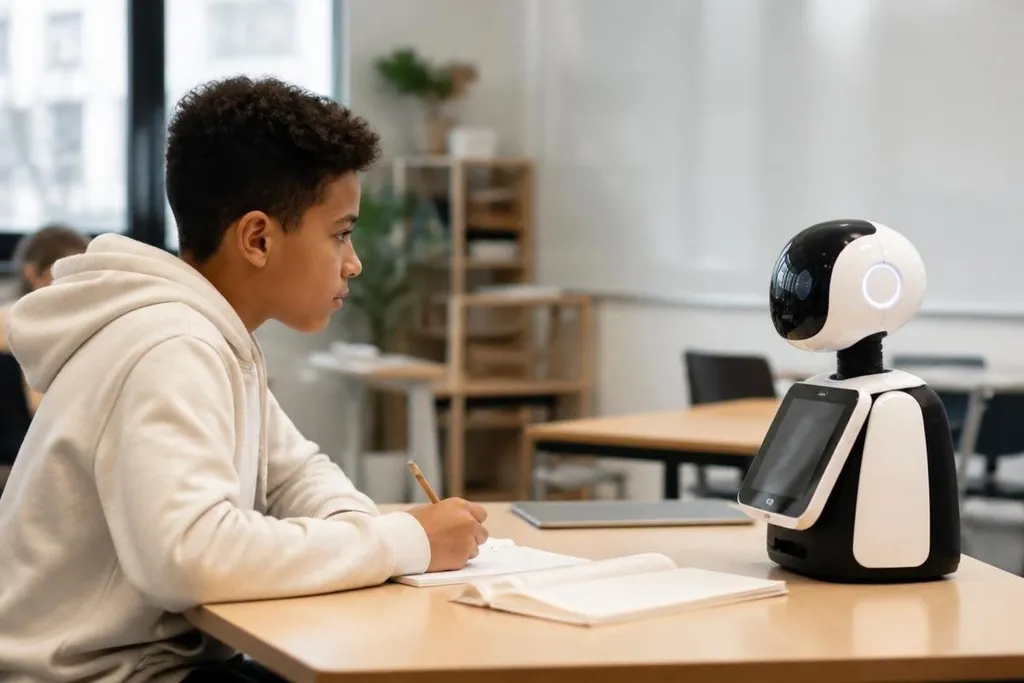
A robot tutor can ask questions, give feedback, and guide practice through a lesson. The harder question is simple: does a physical robot help a student learn better than a teacher, book, or screen?
- A tutor robot needs a clear teaching task.
- Voice, movement, and software must work together.
- Classroom proof matters more than a polished demo.
What a robot tutor does
The phrase covers several machines. One may guide a student through spoken questions. Another may move around a room, point to objects, or use a screen to show the next exercise. The hardware matters only when it helps with a learning task.
A useful system needs four working parts. It must hear the student, understand the answer, choose the next prompt, and respond in a form the student can follow.
A delay in any part can break the lesson, especially when the student is still learning to read or speak. The robot also needs a defined subject. Reading practice, language drills, and repeated maths questions are easier to measure than open discussion. A narrow task gives a school a way to check progress before buying more machines.
The classroom test
A trial should begin with one lesson, one age group, and one result to measure. A 20-minute reading session could track completed questions, help requests, and answers that needed teacher correction. Those figures would show what the robot did during class.
They would not prove that students learned more. The trial would need a second measure, such as a later test on the same skill. It would also need a fair comparison with the usual lesson, since novelty can change how students behave for a short time.
The teacher's workload deserves its own measure. If a robot asks staff to repair cables, repeat instructions, or check every answer, it may add work instead of removing it. That result still matters. Schools buy time as much as they buy equipment.
A classroom trial needs more than a friendly exchange. It should name the robot, the task, and the measured result. Industry readers can use Robot24.com to check those details before deciding whether the system saves teacher time or adds work.
Where the hardware helps
A physical robot can give a lesson a fixed place in the room. Its head, arm, or screen can point toward the current task, which may help a young student follow the session. That benefit depends on clear movement and reliable speech.
The body also creates limits. Motors need power, joints can fail, and microphones can struggle when several students speak at once. A robot that works well beside one student may need different hardware for a group lesson.
Safety adds another test. The machine needs a reachable stop control, safe movement near children, and a clear plan for faults. A school also needs to know who checks the robot before class and who takes over when it stops.
The part software cannot solve
A tutor robot can react to an answer, but teaching includes judgment. A teacher can notice that a student is tired, confused, or worried. Software may miss that signal, even when its speech recognition works well.
Privacy needs a written rule before any trial starts. A school should record what the robot hears, where those files go, how long they stay there, and who can read them. The same questions apply to video, names, and test results.
Price is another open point. No product price, school deployment count, study, or date was supplied for this topic, so claims about market growth would be guesswork. A buyer should ask for those details before treating a robot tutor as a proven product.
A buyer's checklist
Use these checks before a classroom trial:
- Name the skill: Write the exact lesson result in one sentence.
- Set the comparison: Record what the teacher or current software does today.
- Measure teacher time: Count setup, repairs, supervision, and pack-away work.
- Check the data: List every recording, storage location, retention period, and person with access.
- Plan failure: Give the teacher a manual lesson for power, network, or speech problems.
- Review the result: Keep the trial small until later test scores support a wider rollout.
What happens next
Robot tutors may find a place in repeated practice, where the task is narrow and the result can be checked. I'd wait for named classrooms, clear comparison tests, and published follow-up scores before calling the rise real.